
我们的公司
Are High‑Performance Nylons Necessarily Expensive? Material Cost‑Performance Ratio from the Perspective of Failure Costs 2
最新消息和博客

Are High‑Performance Nylons Necessarily Expensive? Material Cost‑Performance Ratio from the Perspective of Failure Costs 2

Are High‑Performance Nylons Necessarily Expensive? Material Cost‑Performance Ratio from the Perspective of Failure Costs 2

May 14, 2026

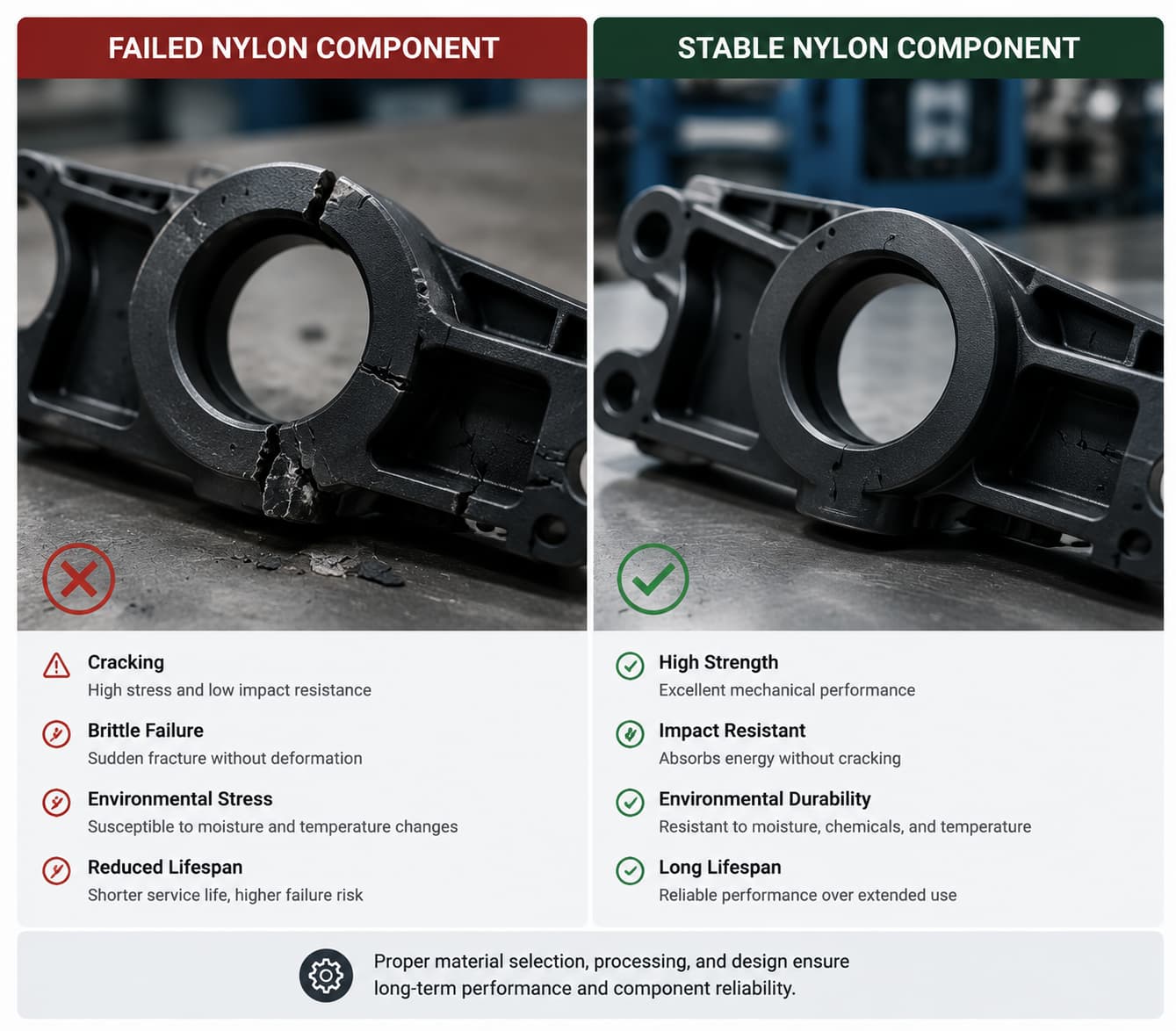
Another often overlooked factor is processing stability. High-performance polyamides typically operate within narrower but more predictable processing windows. Once optimized, they tend to produce lower scrap rates and more consistent part quality. In contrast, lower-cost materials may exhibit greater sensitivity to processing variations, leading to higher rejection rates and hidden production costs.

Experienced engineering teams rarely rely on unit price comparison alone. Instead, they develop failure models to evaluate risk probabilities under different service conditions. For instance, in high-humidity environments, PA6 can absorb over 3% moisture, while PA66 typically remains around 2%. This difference directly impacts dimensional stability and mechanical integrity over time.

Ultimately, the perception of “expensive material” depends on the time horizon. From a procurement perspective, high-performance polyamides carry a higher upfront cost. From a lifecycle perspective, they often provide superior cost efficiency by reducing failure risks.

The main challenge lies in quantifying these hidden costs. In practice, this can be approached through pilot production, accelerated aging tests, and historical performance benchmarking. Such methods enable more rational, data-driven material selection decisions.

Material selection is not merely a cost decision—it is fundamentally a risk management strategy.

Demonstrate Flow and Cooling Differences of Nylon 66

留言

留言
如果您对我们的产品感兴趣并想了解更多详细信息,请在此处留言,我们会尽快回复您。
提交

产品

WhatsApp

接触