
我们的公司
Injection Molding Grade vs. Extrusion Grade Modified Nylon: Essential Differences in Formulation Design and Processing Requirements 01
最新消息和博客

Injection Molding Grade vs. Extrusion Grade Modified Nylon: Essential Differences in Formulation Design and Processing Requirements 01

Injection Molding Grade vs. Extrusion Grade Modified Nylon: Essential Differences in Formulation Design and Processing Requirements 01

July 23, 2026

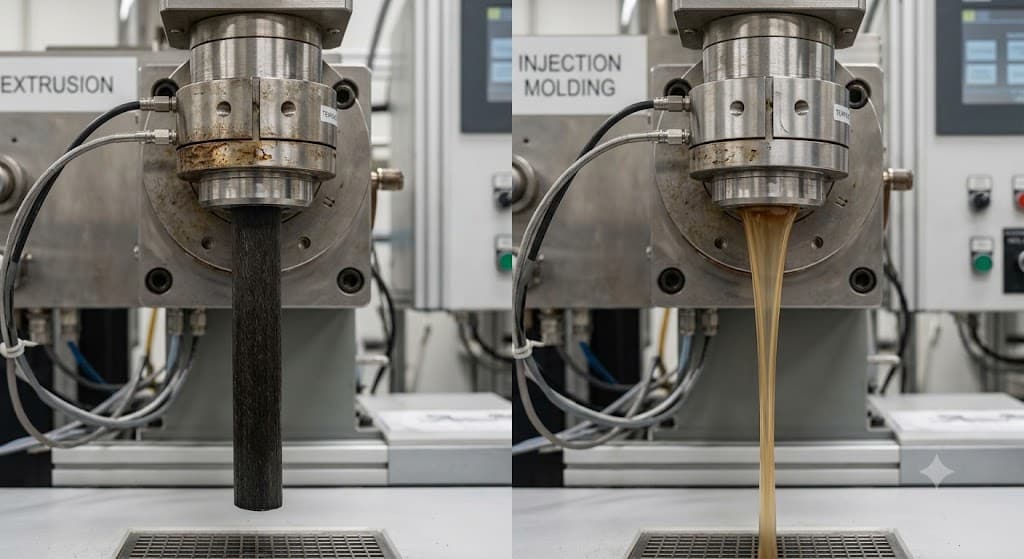
In the engineering plastics sector, modified nylon (PA6/PA66) stands out for its structural versatility. However, it presents fundamentally distinct processing logic when subjected to injection molding versus extrusion techniques. In B2B technical procurement and material selection, client focus extends beyond ultimate tensile strength or heat deflection temperatures. They prioritize processing stability and long-term dimensional reliability under specific conversion conditions. Common production anomalies—such as wall thickness variations in extruded tubing, profile sag, or flash, sink marks, and residual stress cracking in complex injection-molded components—frequently stem not from equipment calibration flaws, but from a fundamental misunderstanding of the divergent formulation requirements for injection versus extrusion grades. Mastering molecular weight distribution, rheological profiles, and functional additive behavior under varying shear fields forms the foundation for resolving these field-level engineering challenges.

From a polymer physics perspective, the core distinction between injection and extrusion grades lies in melt rheology and molecular architecture. Injection molding is defined by high shear rates, elevated pressures, and rapid cavity filling. The polymer melt must navigate intricate mold geometries within fraction of a second, necessitating pronounced shear-thinning behavior—a swift decrease in apparent viscosity alongside low zero-shear viscosity and high melt flow index (MFI). Consequently, injection molding formulations rely on matrix resins with relatively low number-average molecular weight and narrow molecular weight distribution to minimize flow resistance and cycle times. Conversely, extrusion processing (covering pipes, rods, films, and profiles) operates under low shear rates and continuous output without full mold wall containment before solidification. The extrudate must maintain its structural geometry upon exiting the die head prior to cooling, demanding high melt strength and parison sag resistance. Extrusion-grade nylons thus utilize high molecular weight, high relative viscosity resins, frequently enhanced via solid-state polymerization or chain extension. Their broader or long-chain branched architectures supply higher entanglement density, sustaining elevated viscosity and melt elasticity under low shear to prevent melt fracture and gravity-induced deformation.

This trade-off between melt flowability and melt strength dictates contrasting formulation strategies. Consider glass-fiber-reinforced (GFR) modifications: injection grades incorporate low-molecular-weight dispersants and flow promoters to achieve high surface finish and rapid mold filling, enabling short-cut glass fibers to align along flow paths while suppressing surface fiber emergence. Extrusion-grade GFR nylon, however, must prevent extrudate swell and cross-sectional distortion caused by chaotic fiber orientation at the die exit. Formulations thus integrate long-chain polymeric compatibilizers or high-molecular-weight internal lubricants that stabilize low-shear viscosity while optimizing interfacial shear transfer. Divergence is equally evident in toughening systems. While injection-molded parts achieve impact resistance via discrete elastomer dispersions (e.g., POE-g-MAH) with domain sizes of 0.1 to 0.5 microns, such conventional modifiers struggle to achieve fine dispersion under the low-shear profile of extrusion screws. Furthermore, they risk domain coarsening in continuous melt flows, producing "sharkskin" surface defects or longitudinal fracture lines. Extrusion toughening formulations instead utilize reactive polymeric networks or block copolymers that undergo in-situ interfacial reaction, ensuring stable, finely dispersed phase separation under minimal shear.

nylon

留言

留言
如果您对我们的产品感兴趣并想了解更多详细信息,请在此处留言,我们会尽快回复您。
提交

产品

WhatsApp

接触