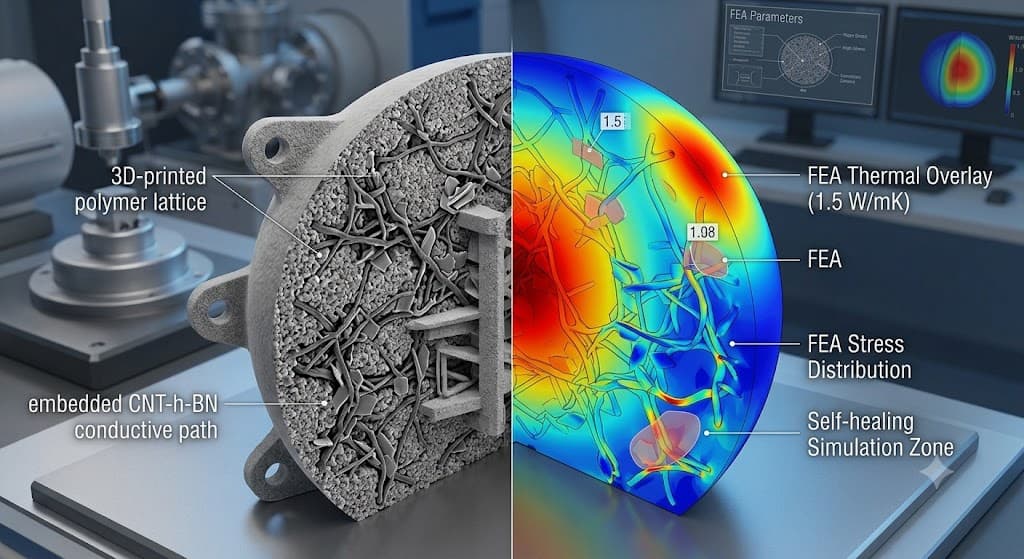

Parallel to electrical dissipation is the escalating challenge of thermal management within highly integrated, space-constrained industrial assemblies. In 5G base station radomes, high-power LED arrays, and EV battery encloure trays, elevated power densities cause severe localized heat accumulation. Operating temperatures surpassing 85 degrees Celsius exponentially accelerate electronic component degradation. Since pristine PA12 features a low intrinsic thermal conductivity of approximately 0.25 W/(m·K), it functions essentially as thermal insulation under high heat flux, inducing significant internal thermal stresses and subsequent warpage. The B2B market urgently requires 3D-printed topologies that offer complex internal cooling channels alongside high, isotropic thermal dissipation. Next-generation thermally conductive PA12 powders deploy hybrid fill systems, co-blending insulating yet highly conductive hexagonal boron nitride (h-BN) or aluminum micro-powders with conductive carbon allotropes. By modulating laser scanning trajectories during sintering, platelet or fibrous fillers align within the melt pool's localized shear flow field, driving out-of-plane or in-plane thermal conductivity to ranges between 1.5 W/(m·K) and over 3.5 W/(m·K). In high-power inverter testing, enclosures fabricated from this advanced powder reduced core chip operating temperatures by 18 to 22 degrees Celsius, eliminating heavy external cooling configurations.
Regardless of initial physical benchmarks, industrial hardware subjected to long-term cyclic loading, alternating thermal fatigue, and chemical exposure inevitably develops micro-cracks. In inaccessible environments like aerospace ducting or deep-sea exploration vessels where routine physical maintenance is impossible, these micro-cracks propagate under stress into macroscopic structural failures, triggering sudden systemic downtime. Traditional asset management depends on destructive testing and frequent component replacement, incurring massive operational expenditure. The frontiers of advanced PA12 development focus on integrating "smart self-healing" mechanisms into the polymer infrastructure. Current industrially viable pathways utilize dynamic reversible covalent networks, such as Diels-Alder (D-A) chemistry, or embedded microencapsulation. Upon micro-crack initiation driven by fatigue, stress concentrations fracture localized microcapsules, releasing low-viscosity healing agents that infiltrate the crack via capillary forces and polymerize under ambient conditions. Alternatively, non-destructive external stimuli like infrared radiation or electro-thermal induction can trigger the dissociation and recombination of reversible bonds across the fractured interface. Validation testing indicates that self-healing PA12 components retain over 85% of their original tensile strength post-repair, extending component operational lifespan by three to five folds under severe high-dynamic fatigue conditions.