
我们的公司
Fatigue Life Evaluation Methods for Carbon Fiber Reinforced Nylon in Mechanical Power Transmission Components
博客

Fatigue Life Evaluation Methods for Carbon Fiber Reinforced Nylon in Mechanical Power Transmission Components

Fatigue Life Evaluation Methods for Carbon Fiber Reinforced Nylon in Mechanical Power Transmission Components

December 10, 2025

Carbon fiber reinforced nylon has become an important lightweight structural material due to its high specific strength, stiffness, and good processability. As mechanical systems move toward lightweight designs, accurately evaluating the fatigue life of this composite under complex loading conditions is essential. Classical metal fatigue theories do not fully apply to polymer composites, so dedicated methodologies must be developed.

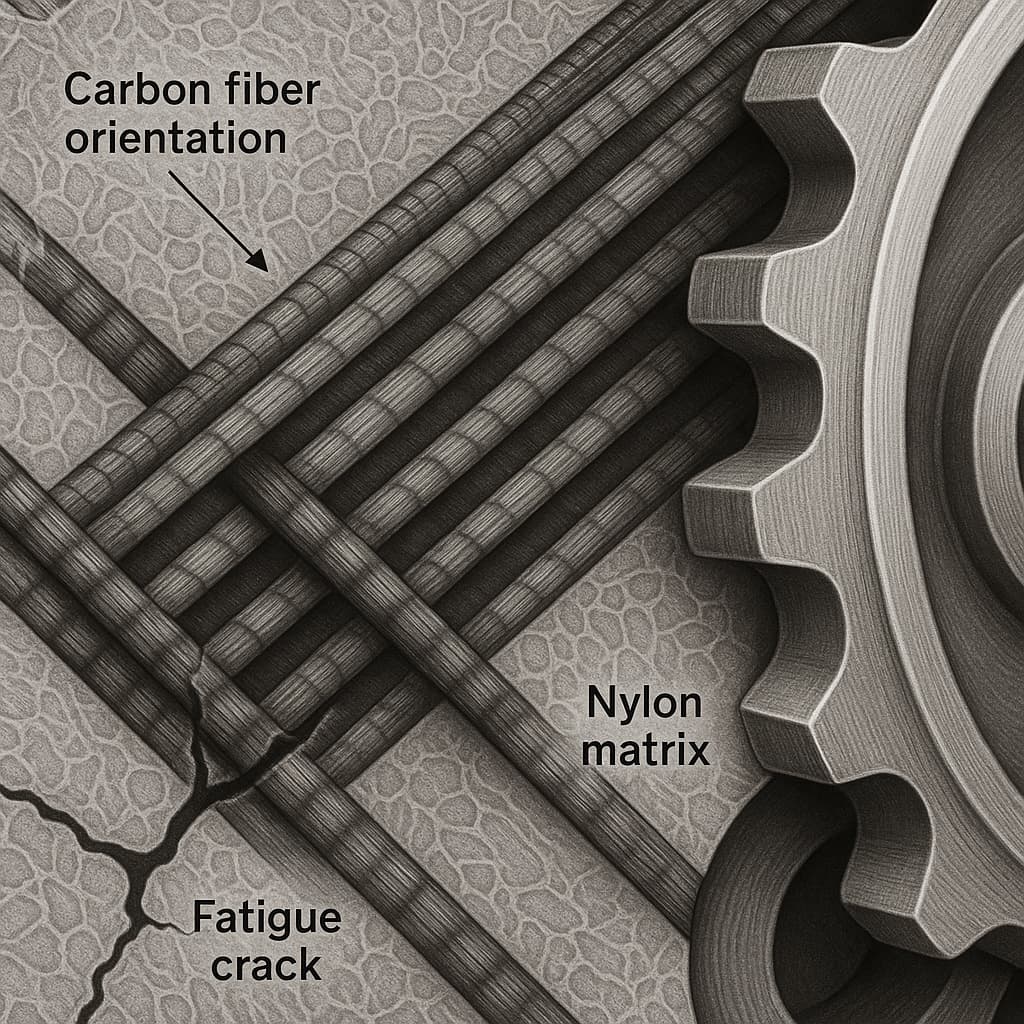
Fatigue evaluation begins with understanding the composite’s microstructure. Fiber orientation, distribution, and interfacial adhesion significantly influence load transfer. Under cyclic loads, carbon fibers bear most of the tensile and bending stresses, while the nylon matrix provides toughness and delays crack propagation. Microstructural characterization tools such as SEM and micro-CT help analyze fiber orientation patterns and their effects on fatigue behavior.

In practice, stress-controlled S-N curve testing is commonly used. Since nylon is sensitive to moisture and temperature, specimens must be conditioned before testing. However, carbon fiber reinforced nylon exhibits multiple damage mechanisms—fiber breakage, interfacial debonding, and matrix yielding—which limits the predictive power of S-N curves alone.

Therefore, fracture mechanics-based crack growth models are increasingly applied. Measuring fatigue crack growth rate under various stress intensity factors helps establish a ΔK–da/dN model that reflects real crack propagation behavior. Finite element simulations incorporating fiber orientation and complex geometry further enhance prediction accuracy.

In applications such as gears, pulleys, brackets, and couplings, additional factors—including contact stress, lubrication, and frictional heating—must be considered. Realistic test conditions help bridge the gap between laboratory results and field performance.

A comprehensive evaluation combining microstructural analysis, S-N testing, crack growth modeling, and numerical simulation provides the most reliable prediction of service life.


留言

留言
如果您对我们的产品感兴趣并想了解更多详细信息,请在此处留言,我们会尽快回复您。
提交

产品

WhatsApp

接触