
我们的公司
Why Does PA66 Fail More Easily Than PPA in Certain High-Temperature Electrical Applications? Section1
博客

Why Does PA66 Fail More Easily Than PPA in Certain High-Temperature Electrical Applications? Section1

Why Does PA66 Fail More Easily Than PPA in Certain High-Temperature Electrical Applications? Section1

January 21, 2026

In high-temperature electrical applications, PA66 has long been regarded as a safe and familiar choice. In many automotive and industrial electrical systems, it is often included in the initial material shortlist simply because its performance range, processing behavior, and supply stability are well understood. This familiarity provides a sense of confidence during early project stages. However, in real-world applications, some failures only become evident after months or years of operation, rather than during prototype validation.

In new energy electrical systems, this issue is particularly noticeable. Components may pass qualification tests and initial thermal evaluations without difficulty, yet gradually exhibit insulation degradation, increased leakage risk, or even localized carbonization during long-term service. These failures rarely originate from a single cause; instead, they result from the combined effects of thermal stress, electric fields, and environmental humidity.

From an application standpoint, high-temperature electrical components are continuously exposed to multiple stress factors. In electric control modules, operating temperatures of 130–150°C are common, accompanied by thermal cycling and fluctuating humidity. Under such conditions, short-term laboratory data often fails to predict long-term material behavior.

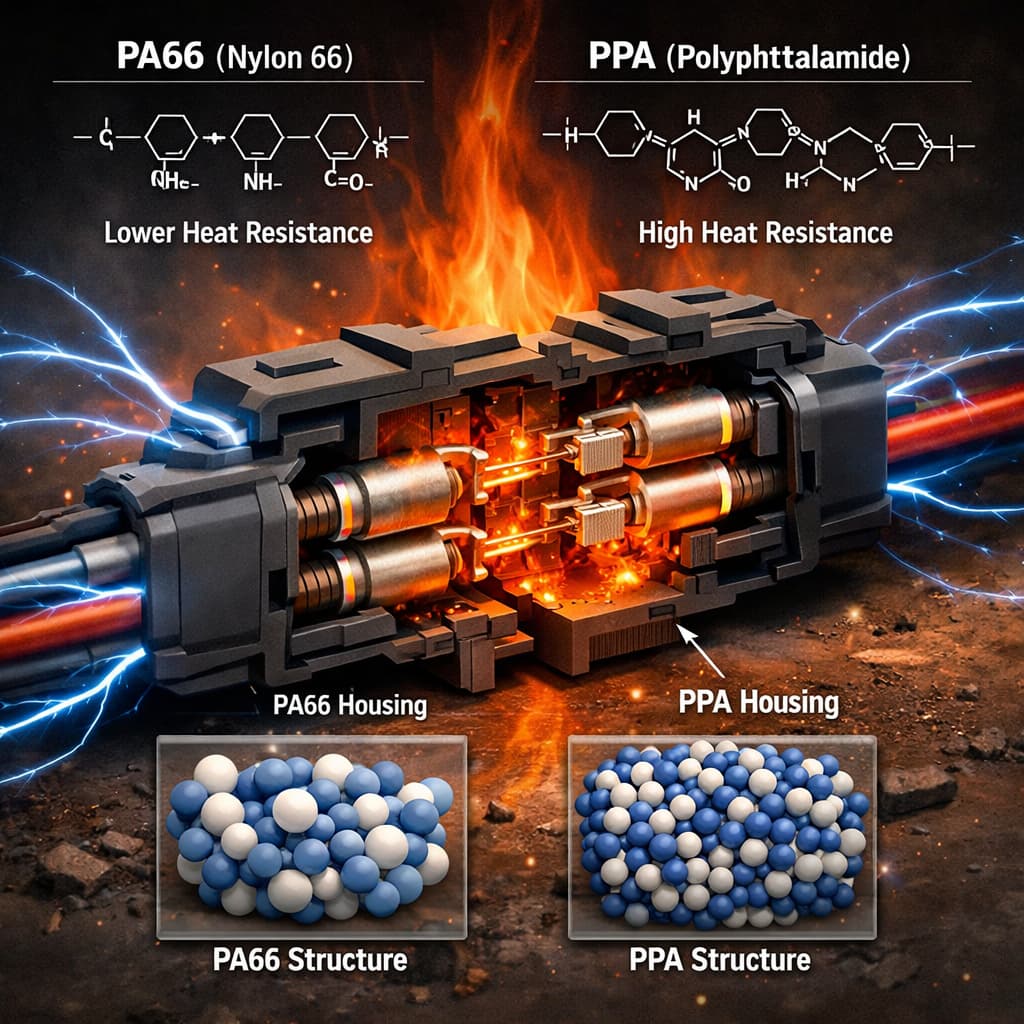
The molecular structure of PA66 helps explain this phenomenon. As an aliphatic polyamide, PA66 consists mainly of methylene segments with relatively dispersed amide groups. While this structure provides good toughness and processing flexibility under normal conditions, elevated temperatures significantly increase molecular mobility. As free volume increases, polar group migration becomes easier, which gradually compromises electrical insulation performance.

PA66 and PPA difference

留言

留言
如果您对我们的产品感兴趣并想了解更多详细信息,请在此处留言,我们会尽快回复您。
提交

产品

WhatsApp

接触