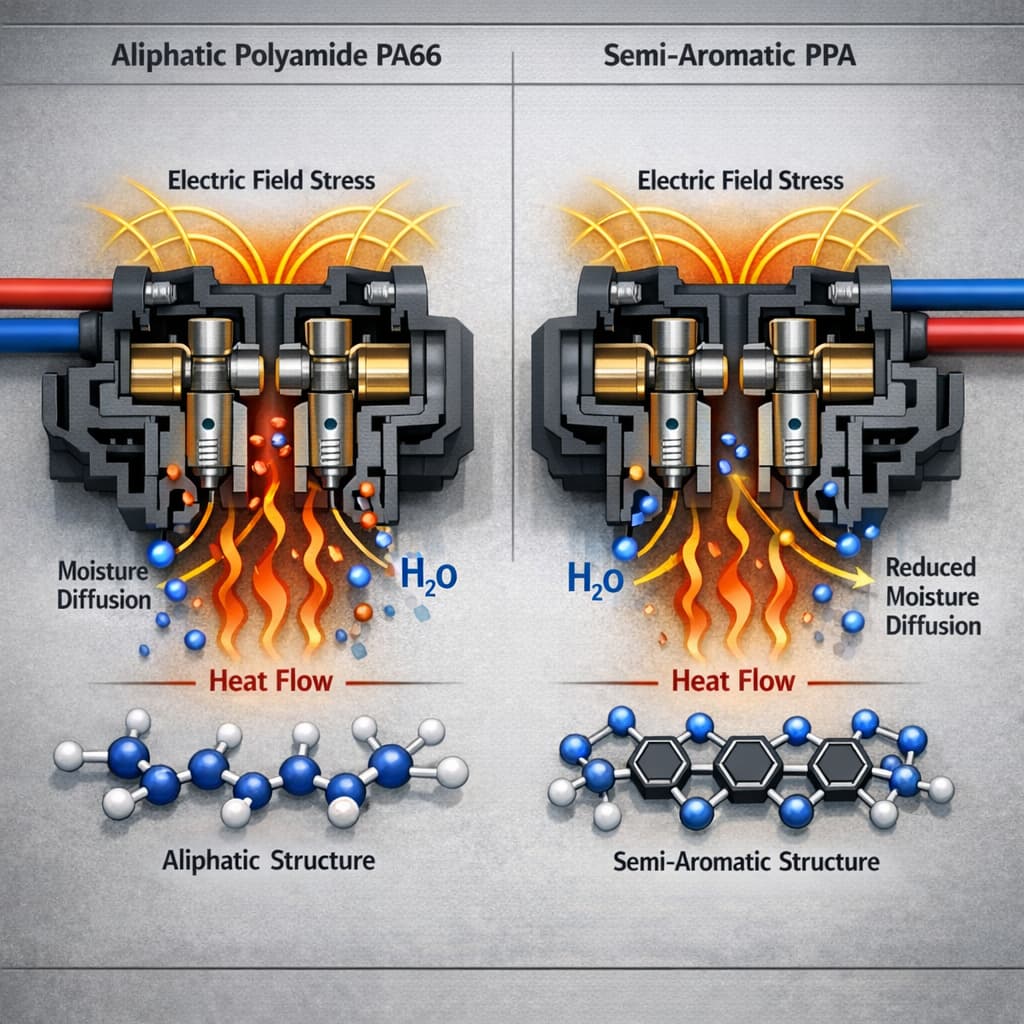

Moisture absorption is another factor that is frequently underestimated. Even in glass fiber reinforced or flame-retardant grades, PA66 retains a higher equilibrium moisture content than semi-aromatic polyamides. In electrical environments, absorbed moisture does more than cause dimensional change; under an electric field, it contributes to conductive path formation, accelerating the decline in volume resistivity. This explains why PA66 components may perform well in dry-state testing but approach critical limits after hydrothermal aging.
PPA behaves differently due to its semi-aromatic molecular structure. The introduction of aromatic rings restricts chain mobility and stabilizes the polymer network at elevated temperatures. As a result, PPA generally exhibits more stable electrical properties during long-term thermal exposure. Its lower moisture absorption further slows performance degradation in humid conditions.
Engineering test data reflects this trend. After 1000 hours of aging at 150°C, glass fiber reinforced PA66 often shows a pronounced drop in volume resistivity, sometimes exceeding one order of magnitude. Under comparable reinforcement conditions, PPA compounds typically exhibit more moderate and controllable degradation. Similar tendencies can be observed in CTI performance.
This does not imply that PA66 is unsuitable for high-temperature electrical applications. The challenge lies in correctly defining its application limits. When long-term thermal exposure, electrical stress, and high reliability requirements coexist, the safety margin of PA66 becomes narrower. The advantage of PPA lies not in peak performance values, but in its stability over the entire service life.